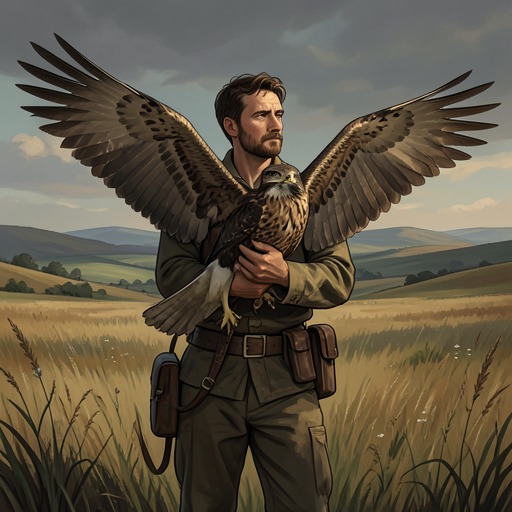
T. H. White’s concealed homosexuality
H is for HawkT. H. White’s concealed homosexuality is presented as a force that shaped his public self, his intimate life, and his writing about animals and the countryside. Seeking approval while hiding desires he believed could not be returned, he performed conventional masculinity and tried to imagine that analysis might remake him. His attachment to landscapes and independent animals offered forms of love and identification that seemed safer than human intimacy, but did not resolve his loneliness.
Concealment and the performance of belonging
When White took up his position at Stowe in 1932, he was already practiced at hiding who he was. He followed Henry Green’s advice that a person who might not fit should take as great a part as possible in what was going on. After leaving Cambridge with a First in English, White decided to become a “toff,” adopting the pursuits associated with the identity he wanted to pass as: shooting, fishing, flying, and foxhunting. His anxious questions about the correct hunting clothes, down to the shade and weave of his breeches, reveal how much belonging depended on getting the details right.
The performance was more than social polish. White kept meticulous hunting diaries recording miles ridden, coverts drawn, people encountered, obstacles crossed, and whether he had behaved properly. His cautious report that he believed he had not misbehaved and had not been rebuked makes approval legible through what had not gone wrong. The same defensive logic informed his description of Buckinghamshire in England Have My Bones: the county was safe because it lacked conspicuous qualities and concealed its individuality. The book reads this landscape as a mirror of White’s own guarded character, where concealment helps preserve what cannot safely be displayed.
The hoped-for cure
For a year, White’s interest in psychoanalysis was intense. He believed his analyst, Bennet, might cure his homosexuality along with his unhappiness, sense of unreality, sadism, confusions, and fears. In a letter to Leonard Potts, his former Cambridge tutor and a father figure, White called Bennet a great man because cured cases like his were supposedly rare. He even described a supposedly transformed acquaintance, a sadistic homosexual now happily married with children: a reassuring future that the narrative presents as wishful invention rather than evidence of change.
At this point White thought he might be in love with a barmaid and reported to Potts that he was so happy he hopped through the streets like a wagtail. The exhilaration sits beside his terror of failure: the hope of being cured and accepted did not displace the fear that he would fail to become someone lovable. Later he told Potts that the barmaid was a “complete write-off.” The episode marks neither a resolution nor a successful heterosexual future; instead, it exposes the precariousness of the self White was trying to construct.
Landscape and displaced desire
In England Have My Bones, White wrote, “Falling in love is a desolating experience, but not when it is with a countryside.” The book interprets this attachment as a safer object for desire: a landscape could not return his love, but neither could it injure him as a human relationship might. White’s love of the countryside was therefore not merely a retreat into scenery. It offered a subject he could write about openly, while the human longing beneath it remained difficult to name.
White’s final meeting with David Garnett brought a more direct account of his conflict: White confessed that he was a sadist. Garnett associated this with White’s early emotional maltreatment and years of flogging at school, describing a tender-hearted and sensitive man caught between sincerity that could be cruel and falseness that felt unnatural. In either direction, Garnett wrote, White revolted the person he loved and disgusted himself. This account connects concealed sexuality to a wider fear that intimacy would expose him as harmful or unacceptable, rather than presenting concealment as a simple choice between public and private identities.
Animals, independence, and literary kinship
The book places White in a literary tradition of gay writers who wrote about relationships with animals when human attachments were difficult to discuss. It points to Gavin Maxwell’s Ring of Bright Water and to Maxwell Knight’s account of hand-rearing a cuckoo, whose hidden life and dependence made the bird especially resonant to the narrator. White, too, filled his life and books with animals: dogs, owls, hawks, snakes, badgers, hedgehogs, and ants. He insisted that animals were not pets, regarding pet ownership as a dangerous dependency that could ruin both owner and creature.
White’s ideal was a self-contained creature whose life remained its own. He bought Siamese cats, a breed known for independence, and tried to train them to rely on and feel affection for nobody but themselves; they continued to sleep in his sitting room and beg him for food. Grass snakes suited him better because he felt they could not be imposed upon or made to surrender their affections. He loved them as misunderstood and irreducibly themselves—qualities he aspired to embody. The book links that aspiration to the independent animals and figures he created, including Merlyn, the Wart, and Sir Lancelot.
Exposure and retreat
By the time White dreamed of a hawk, the performed identity was under strain. He described himself as boiling with unrest, was increasingly inclined to shock people, had turned against foxhunting and flying, and said that he hated people and preferred animals. Those former pursuits had become entangled for him with death, snobbery, and the pressure to excel. His attempt to belong through conventional masculine activities had not made the concealed self disappear; he now judged the motives behind that performance as wrong.
White’s response was to seek splendid isolation. He went fishing alone in Belmullet, on Ireland’s west coast, and resigned from Stowe, acknowledging to Potts that his analyst had taken him only a quarter of the way and that he did not know what future he had. The narrative thus leaves his concealed homosexuality unresolved: retreat loosens his investment in social performance, but offers no cure or returned human love. His animals and landscapes remain powerful refuges, charged with the independence and safety he sought, while the gap between concealment and intimacy persists.